
Categories
- Articles

- Blogs and Op-eds
- News
- Quora Questions and More
Related Books
UNFOLDED: India’s Air Defence from WWII to Operation Sindoor

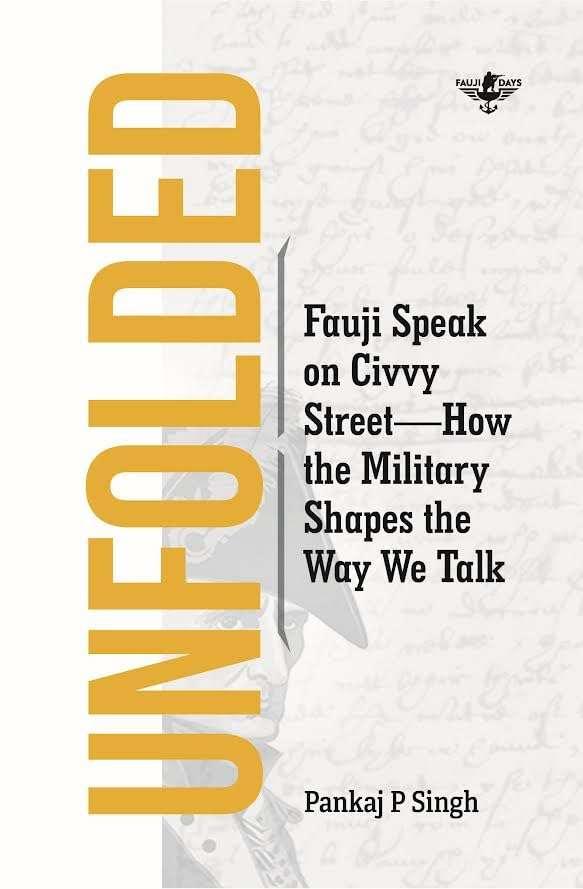
Exclusive Excerpt from Unfolded: Fauji Speak on Civvy Street
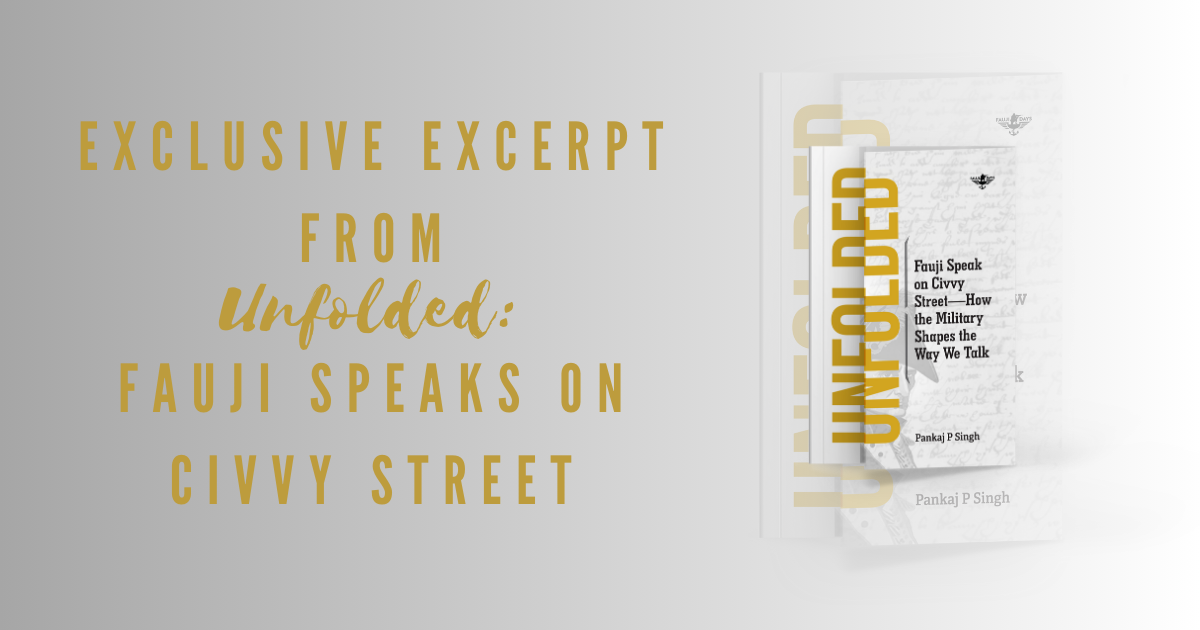 Exclusive Excerpt from Unfolded
Some books don’t announce themselves with explosions; they unsettle you with recognition. Unfolded: Fauji Speaks on Civvy Street does exactly that. Written from the vantage point of someone steeped in military life yet alert to the rhythms of civilian discourse, the book examines how conflict doesn’t merely shape borders and policies—it reshapes language itself.
This exclusive excerpt focuses on one deceptively familiar terrain: journalism. Not war reporting alone, but everyday headlines, commentary, and media shorthand. The argument is simple, unsettling, and persuasive—war has slipped from the battlefield into our vocabulary, and we barely notice anymore.
Also read: Exclusive Excerpt from The POW Who Saved Kashmir
Exclusive Excerpt – How the Language of War Took Over Journalism
Here’s an exclusive excerpt from Unfolded by Pankaj P Singh, exploring how battlefield vocabulary has slipped into newsrooms and come to frame everyday narratives.
News, it is often said, is the first rough draft of history. But increasingly, it is also the battlefield of language, and nowhere is this more evident than in how journalism has absorbed and amplified military terminology. From headlines to hashtags, from op-eds to on-the-ground reporting, the language of war has become the default setting for drama, urgency, and even routine coverage. The war correspondent may be a specialised role, but war-like language has become every journalist’s weapon of choice.
Take onslaught. Originally describing a ferocious enemy attack—arrows raining down, walls breached, lines broken—it now appears in “an onslaught of criticism,” “an onslaught of memes,” or “an onslaught of rainfall.” The metaphor retains power because it evokes something overwhelming and violent, even when applied to a barrage of tweets.
Consider siege. Cities in history were besieged—cut off, starved, bombarded. Today, political candidates are “under siege” from opponents. Celebrities face “media sieges.” Small towns experience “sieges of tourists.” The word’s power lies in its implication of being trapped, surrounded, pressured—perfect for tabloid tension.
The frontline is no longer just the first row of soldiers—it’s a hospital ward during COVID, a school in a conflict zone, even an activist’s Twitter feed. During the pandemic, healthcare workers were repeatedly described as “frontline warriors,” reinforcing the idea that hospitals had become war zones. The military metaphor was embraced partly to honour sacrifice, but also because it helped frame an invisible enemy—the virus as invader, the cure as counterattack.
Battleground has fared similarly. What was once terrain soaked in blood is now a metaphor for swing states (“battleground states”), corporate rivalry (“battleground markets”), or even dating (“modern relationships are a battleground”). It lends gravity, stakes, and the illusion of strategic order to otherwise chaotic spaces.
Journalists love firestorm. While the term gained dramatic prominence describing WWII bombing casualties—Dresden, Tokyo, Hiroshima—its metaphorical use for controversy predates these events. Still, the wartime associations strengthened its impact. Now it means public backlash, scandal, and media frenzy. “The minister’s comments sparked a firestorm.” The image of destruction by heat and wind clings to the phrase, even when flames are metaphorical.
During the 2003 Iraq War, television networks like CNN and Fox popularised shock and awe—a military doctrine of overwhelming force designed to paralyse the enemy. Within weeks, it migrated to describe Oscar performances, advertising campaigns, and even restaurant menus. The language of spectacle and domination had found a glossier stage.
Headlines feature words like target, strike, blow, defence, assault, retaliation, breach, milestone—all from military contexts. They’re punchy, evocative, and compress meaning. Prime ministers don’t rebut—they strike back. Companies don’t underperform—they take hits. Stock markets don’t dip—they plummet under pressure.
This warlike vocabulary dominates sports coverage (defensive play, attacking strategy, counter-offensive), business news (hostile takeover, market siege, boardroom coup), even weather reports (cold front advances, storm barrels through). Our daily media diet trains us to view the world as tactical confrontations. Complexity becomes strategy. Nuance becomes manoeuvre. Debate becomes battle.
The Quiet Power of This Excerpt
What makes this passage striking is not just its linguistic sharpness, but its restraint. There is no rant against journalists, no moral grandstanding. Instead, the author calmly maps how military vocabulary has become a convenient shortcut—dramatic, efficient, emotionally loaded.
The insight is particularly powerful coming from a fauji voice. In uniform, words like frontline, assault, or firestorm carry real consequences—injury, loss, escalation. On civvy street, those same words are deployed casually, often carelessly, to describe disagreements, market trends, or online outrage. The gap between lived violence and metaphorical violence is vast, yet the language collapses it.
The excerpt also hints at a deeper cost. When everything is framed as a battle, compromise looks like surrender. Dialogue feels like weakness. Nuance, as the author notes, becomes manoeuvre—something tactical rather than thoughtful. This has implications far beyond journalism, shaping how societies argue, polarise, and eventually govern themselves.
Unfolded: Fauji Speaks on Civvy Street is not just about civil–military relations or life after uniform. It is about translation—between worlds, experiences, and ways of seeing. This excerpt is a reminder that sometimes, the most decisive fronts are not geographical. They are linguistic.
And we are all standing on them.
Also read: Exclusive Excerpt from India-Pakistan: The Intractable Conflict and The China Factor
Related blogs
“Roger That!”: How a Simple Word Became a Soldier’s Signature
Shakespeare and the Soldier’s Tongue: Military Phrases We Still Use Today
Kilroy Was Here: When Faujis Leave Their Mark on Civvy Street